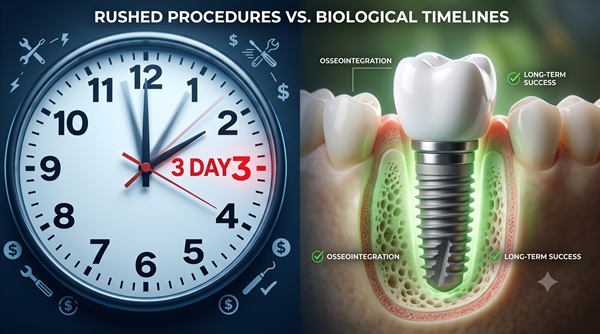
The dental tourism market is booming, with thousands of patients traveling abroad every month seeking to restore their smiles. In this competitive landscape, marketing campaigns have become increasingly aggressive. One of the most alluring promises currently flooding the internet is the concept of “Express Dental Implants”—clinics promising a brand-new, permanent smile completed from start to finish in just three days.
While the prospect of bypassing months of healing is highly tempting for an international patient, the biological reality of human anatomy cannot be rushed by a marketing slogan. Beneath the surface of these “same-day” or “3-day” express packages lies a high risk of mechanical and biological failure. For many patients, the immediate gratification of a quick procedure turns into a long-term medical nightmare involving severe bone loss, chronic infections, and costly reconstructive surgeries.
The Biological Reality: What is Osseointegration?
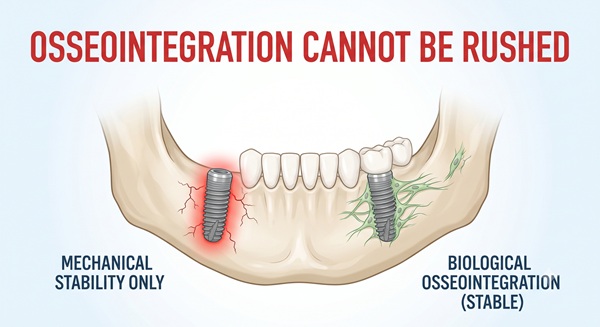
To understand why express dental implants often fail, one must understand how a dental implant actually works. An implant is not merely screwed into the jawbone like a nail into wood; it relies on a vital biological process called osseointegration.
Osseointegration is the direct structural and functional connection between living bone tissue and the surface of a titanium or zirconia implant. This biological fusing does not happen overnight. The human body requires a minimum of 8 to 12 weeks for bone cells to remodel, attach to the microscopic ridges of the implant, and create a stable foundation capable of withstanding the immense force of human chewing.
When a clinic cuts this timeline down to three days and immediately attaches a permanent, heavy prosthetic bridge, they are practicing what is known as premature loading. Without the crucial phase of undisturbed healing, the micro-movements caused by eating and speaking disrupt the delicate new bone cells, preventing fusion and leading to early implant rejection.
Immediate Load vs. Dangerous Shortcuts
It is clinically important to distinguish between legitimate, evidence-based “Immediate Load” protocols and dangerous “Express” marketing gimmicks:
- Legitimate Immediate Loading (The Exception): In highly specific clinical scenarios—where a patient possesses exceptional, dense jawbone volume and undergoes a rigorous multi-point primary stability check—a temporary, highly lightweight crown or bridge can be placed immediately. However, this temporary prosthetic is carefully designed to be completely out of occlusion, meaning it does not touch the opposing teeth when chewing.
- The “Express” Gimmick (The Danger): High-volume commercial clinics frequently apply the same fast-track protocol to every patient, regardless of their bone density, systemic health, or periodontal history. They skip temporary stages entirely, placing heavy, final permanent materials (like zirconia or porcelain fused to metal) directly onto unhealed bone within 72 hours, forcing the patient to return home under a false sense of security.
The Four Technical Risks of Rushed Dentistry
When dental care is compressed into a tight window to accommodate a tourist’s flight schedule, critical clinical steps are compromised. The technical risks include:
1. Compromised Biological Diagnostics
Proper implantology requires a thorough assessment of bone quality and three-dimensional volume using advanced CBCT scans. Rushed clinics often ignore borderline indicators, such as active periodontal disease or severe bone atrophy, that should require preparatory treatments like bone grafting or sinus lifts. Placing implants into compromised bone without adequate preparation ensures eventual failure.
2. The Lack of Mechanical Stabilization
For an implant to survive immediate placement, it must achieve high primary stability upon insertion. If the torque metrics are insufficient during surgery, the implant must be buried under the gum to heal quietly. In an express environment, the commercial pressure to deliver a finished bridge in three days forces practitioners to load implants that are mechanically unstable.
3. Poor Occlusal Distribution
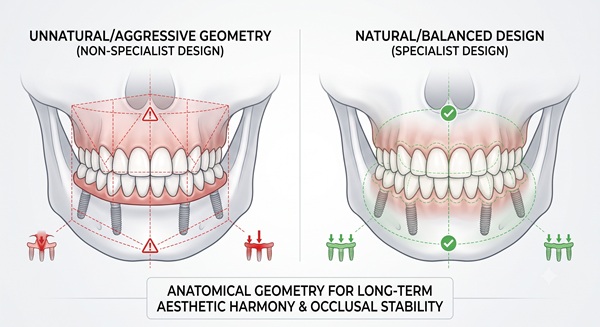
The human bite generates immense pressure. Therefore, dentists must achieve flawless occlusion (bite alignment) when designing a full-arch restoration. However, when laboratories must manufacture a permanent bridge within 24 to 48 hours, they often sacrifice the precision of the fit. As a result, an uneven bite can create destructive lateral forces on unhealed implants. Over time, these forces can accelerate bone resorption around the neck of the fixtures.
4. Chronic Peri-Implantitis and Tissue Management
Soft tissue takes time to mature and form a protective seal around the implant abutment. Fabricating and cementing a permanent bridge over freshly traumatized, swollen gums traps bacteria beneath the gum line. As the swelling goes down weeks later, gaps appear, exposing the implant threads to chronic bacterial colonization, resulting in peri-implantitis (bone-destroying infection).
The True Financial and Physical Cost of Failure
The irony of opting for a “3-day express” dental package to save time and money is that the long-term cost is almost always significantly higher. When an implant fails due to premature loading, it does not simply fall out cleanly. It frequently destroys the surrounding jawbone as it rejects.
Patients who experience express implant failure may require extensive removal surgery, prolonged antibiotic treatment, complex bone-regeneration grafts, and months of healing before dentists can consider another implant attempt. Consequently, a procedure designed to take only three days can quickly become a lengthy corrective process. In some cases, patients may spend years undergoing additional treatments before achieving a stable and functional full-mouth restoration.
How to Identify a Safe Implant Protocol Abroad
If you are planning to travel for dental implants, you can protect your health by choosing clinics that prioritize biological timelines over speed. Look for the following indicators of clinical integrity:
- A Multi-Stage Treatment Plan: A reputable specialist will almost always recommend a two-trip approach for standard cases. Trip one involves the surgical placement of the implants and a well-adjusted, lightweight temporary solution. Trip two occurs 3 to 6 months later, allowing complete osseointegration before the permanent, heavy prosthesis is crafted.
- Surgeon-Led Planning: Ensure that a board-certified Maxillofacial Surgeon or a dedicated Periodontist/Implantologist designs your treatment plan. In contrast, avoid relying solely on a general practitioner who primarily specializes in cosmetic veneers.
- Explicit Guarantees on Bone Evaluation: The clinic should clearly state that it will adapt the treatment plan if surgery does not achieve safe primary stability. This approach protects your bone instead of forcing an immediate prosthetic load.
The Bottom Line
High-quality dentistry requires a synergy between state-of-the-art technology and natural human biology. While modern implantology has advanced significantly, it cannot override the fundamental principles of bone healing. Therefore, patients should prioritize biological recovery over speed. Although an extra trip or several months of patience may seem inconvenient, these efforts represent a small investment. Ultimately, they can help patients avoid the serious consequences of a failed full-mouth restoration. When it comes to your health, speed is the enemy of safety.
At Turk Dental Index, our mission is to cut through the marketing noise and guide international patients toward ethical, transparent dental professionals who prioritize long-term clinical success over commercial speed.
Leave a Reply