Medical Review: This content is supervised and verified by
Dr. Rifat Alsaman.
For patients suffering from severe tooth loss, edentulism, or failing full-arch bridgework, full-mouth restoration using implant-supported fixed prostheses represents the most permanent solution available in modern implantology. When evaluating full-arch reconstruction in Turkey—a leading global destination for advanced oral surgery—the decision inevitably narrows down to two primary protocols: All-on-4 and All-on-6 dental implants. While both techniques eliminate the need for removable dentures, they differ fundamentally in biomechanical load distribution, required bone volume, surgical complexity, and overall cost structure.
Looking for a Trusted Medical Clinic?
Explore our updated rankings and guides, rigorously evaluated based on medical qualifications, technology, and verified patient feedback.
Direct Comparison: All-on-4 vs. All-on-6 at a Glance
Understanding the core clinical and financial differences between these two full-arch restorative options is essential before undergoing a virtual diagnostic evaluation or flying to Turkey for treatment.
| Clinical Parameter | All-on-4 Dental Implants | All-on-6 Dental Implants |
|---|---|---|
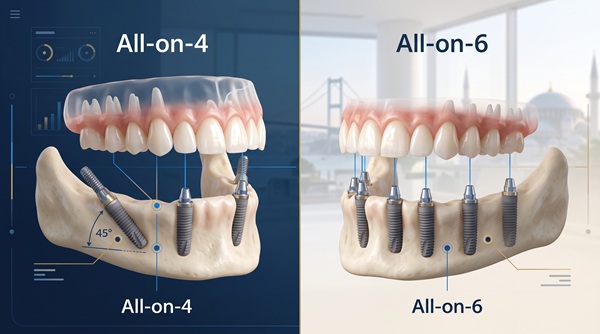
| Number of Implants per Arch | 4 titanium implants (2 straight anterior, 2 angled posterior) | 6 titanium implants (2 straight anterior, 4 angled/straight posterior) |
| Average Cost in Turkey (per Arch) | €2,500 – €4,500 EUR ($2,700 – $4,900 USD) | €3,500 – €6,000 EUR ($3,800 – $6,500 USD) |
| Bone Volume Requirement | Lower posterior requirement, but still needs adequate bone in the front of the jaw | Moderate to high (requires adequate bone volume (height and width) in the posterior regions) |
| Need for Bone Grafting / Sinus Lift | Rarely required (specifically designed to avoid grafting) | More likely if posterior bone height is deficient |
| Biomechanical Load Distribution | Standard forces spread across 4 primary anchor points | More anchor points spread load and add redundancy; however, studies show comparable long-term implant survival for both protocols. |
| Ideal Patient Profile | Patients with bone atrophy, limited budget, or avoiding sinus lifts | Patients with strong jawbone density, strong bite forces, or wider arches |
Anatomical & Surgical Differences Explained
1. Biomechanics and Load-Bearing Dynamics
The primary surgical distinction between All-on-4 and All-on-6 lies in force distribution across the maxillary (upper) or mandibular (lower) jawbone during mastication (chewing). Every time you bite, chewing forces are transferred through the prosthetic teeth into the titanium implants, which act as artificial roots embedded in the bone.
- All-on-4 Mechanics: The two front implants are placed upright (axially), while the two posterior implants are placed at an angle of 30° to 45°. This tilting maximizes contact with existing bone and bypasses the maxillary sinus cavities in the upper jaw and the mental nerve in the lower jaw. However, because only 4 implants typically support a 10–12-tooth fixed bridge, individual mechanical strain per implant is higher.
- All-on-6 Mechanics: By adding two additional posterior implants, the total surface area embedded in the jawbone increases significantly. This extra anchorage creates a more rigid mechanical foundation, distributing bite forces more evenly across the arch. If one implant experiences minor stress or localized bone loss over time, the remaining five fixtures offer a higher safety buffer against total prosthetic failure.
2. Bone Density and Anatomical Requirements
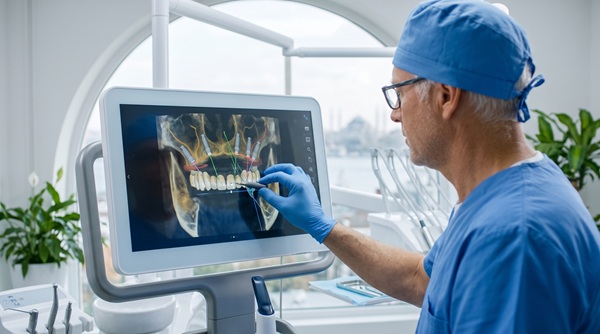
Jawbone resorption occurs naturally when natural teeth are missing for extended periods. The choice between 4 or 6 implants is largely dictated by 3D Cone Beam Computed Tomography (CBCT) scan findings:
- When All-on-4 is clinically indicated: If a patient exhibits moderate bone loss in the molar regions, All-on-4 allows the oral surgeon to utilize the denser bone in the anterior (front) section of the jaw without resorting to invasive bone grafting procedures or sinus floor elevations.
- When All-on-6 is clinically indicated: All-on-6 requires sufficient bone height and width in both anterior and posterior segments. If posterior bone density is insufficient but the patient desires an All-on-6 construction, preliminary procedures such as a sinus lift (in the upper jaw) or guided bone regeneration (GBR) may be required prior to or during implant placement.
Price Comparison in Turkey (2026 Price Benchmark)
One of the main reasons international patients choose Turkey for oral surgery is the significant cost advantage compared to the UK, Europe, or North America—saving 60–75%; quality depends on the clinic, implant brand and clinician.
Cost Factors: What Determines the Final Price?
The cost of full-arch dental reconstruction in Turkish clinics depends on four key variables:
- Implant Brand Tier: Premium Swiss or German brands (e.g., Straumann, Nobel Biocare) cost more than high-quality alternatives (e.g., Osstem – Korea, NucleOSS – Turkey). Remove Medentika or list it correctly as a German brand.
- Prosthetic Material: Acrylic/composite hybrid bridges mounted on a titanium bar are less expensive, whereas monolithic high-translucency Zirconia bridges offer superior aesthetics and durability at a higher price tier.
- Surgical Pre-Treatments: Tooth extractions, bone grafting, sinus lifts, or PRF (Platelet-Rich Fibrin) therapy will add to the base cost.
- Package Inclusions: Most reputable Turkish dental centers bundle treatment with VIP airport transfers, 4 or 5-star hotel accommodations, panoramic X-rays, 3D CBCT scans, and post-op medications into an all-inclusive price.
Cost Breakdown Table: Turkey vs. UK & USA
| Treatment Type (Single Arch) | Average Price in Turkey | Average Price in UK | Average Price in USA |
|---|---|---|---|
| All-on-4 (Standard Tier Implants + Acrylic Bridge) | €2,500 – €3,200 | £10,000 – £14,000 | $15,000 – $22,000 |
| All-on-4 (Premium Straumann / Nobel + Zirconia) | €4,000 – €5,000 | £15,000 – £18,000 | $24,000 – $30,000 |
| All-on-6 (Standard Tier Implants + Zirconia Bridge) | €3,500 – €4,500 | £12,000 – £16,000 | $18,000 – $26,000 |
| All-on-6 (Premium Straumann / Nobel + Full Zirconia) | €5,500 – €6,800 | £17,000 – £22,000 | $28,000 – $36,000 |
Surgical Timeline: What to Expect During Treatment in Turkey
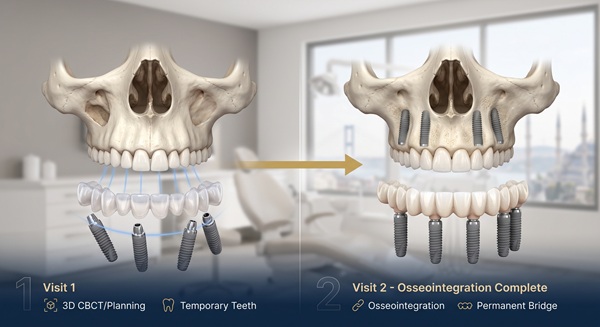
Full-arch dental restoration in Turkey typically requires two distinct visits spaced 3 to 6 months apart to allow for proper osseointegration (bone fusion):
Visit 1: Surgery, Implant Placement & Temporary Bridge (5–7 Days)
- Day 1 (Diagnosis & Planning): In-person clinical exam, digital 3D CBCT scanning, virtual surgical planning, and medical health clearance.
- Day 2 (Surgical Phase): Tooth extractions (if necessary), surgical placement of 4 or 6 implants under local anesthesia or IV sedation, and optical digital impression scanning.
- Day 3–5 (Healing & Temporary Fitting): Fabrication and attachment of a high-density temporary fixed bridge. This allows you to eat soft foods and walk away with functional teeth during the healing phase.
Osseointegration Period (3 to 6 Months)
During this period, you return home while the titanium implants fuse permanently with your jawbone tissue. You wear the temporary fixed prosthetic throughout this recovery phase.
Visit 2: Final Permanent Zirconia / Porcelain Restoration (7–8 Days)
- Day 1: Removal of temporary bridges and digital scanning of fully healed implants.
- Day 2–5: Custom CAD/CAM design and precision milling of your permanent Zirconia or Porcelain-fused-to-titanium full-arch bridge.
- Day 6–7: Trial fitting, bite alignment adjustments, aesthetic review, and final screwing of the permanent bridge onto the implants.
Clinical Verdict: How to Choose Which Option is Right for You
The choice between All-on-4 and All-on-6 should never be made purely based on price; it must be grounded in an objective 3D radiographic assessment of your jawbone anatomy.
Choose All-on-4 if:
- You have experienced long-term tooth loss and moderate posterior bone loss.
- You wish to avoid invasive bone graft surgeries or sinus lifts.
Choose All-on-6 if:
- You have adequate bone density throughout the entire arch (anterior and posterior).
- You have a strong jaw structure or a heavy bite (e.g., bruxism/teeth grinding history).
- You want maximum structural support, superior distribution of bite forces, and long-term redundancy.
Frequently Asked Questions About All-on-4 & All-on-6 in Turkey
Is All-on-6 better than All-on-4?
How long do All-on-4 and All-on-6 implants last?
Are dental implants in Turkey safe and regulated?
Can I get teeth in a single day in Turkey?

Leave a Reply